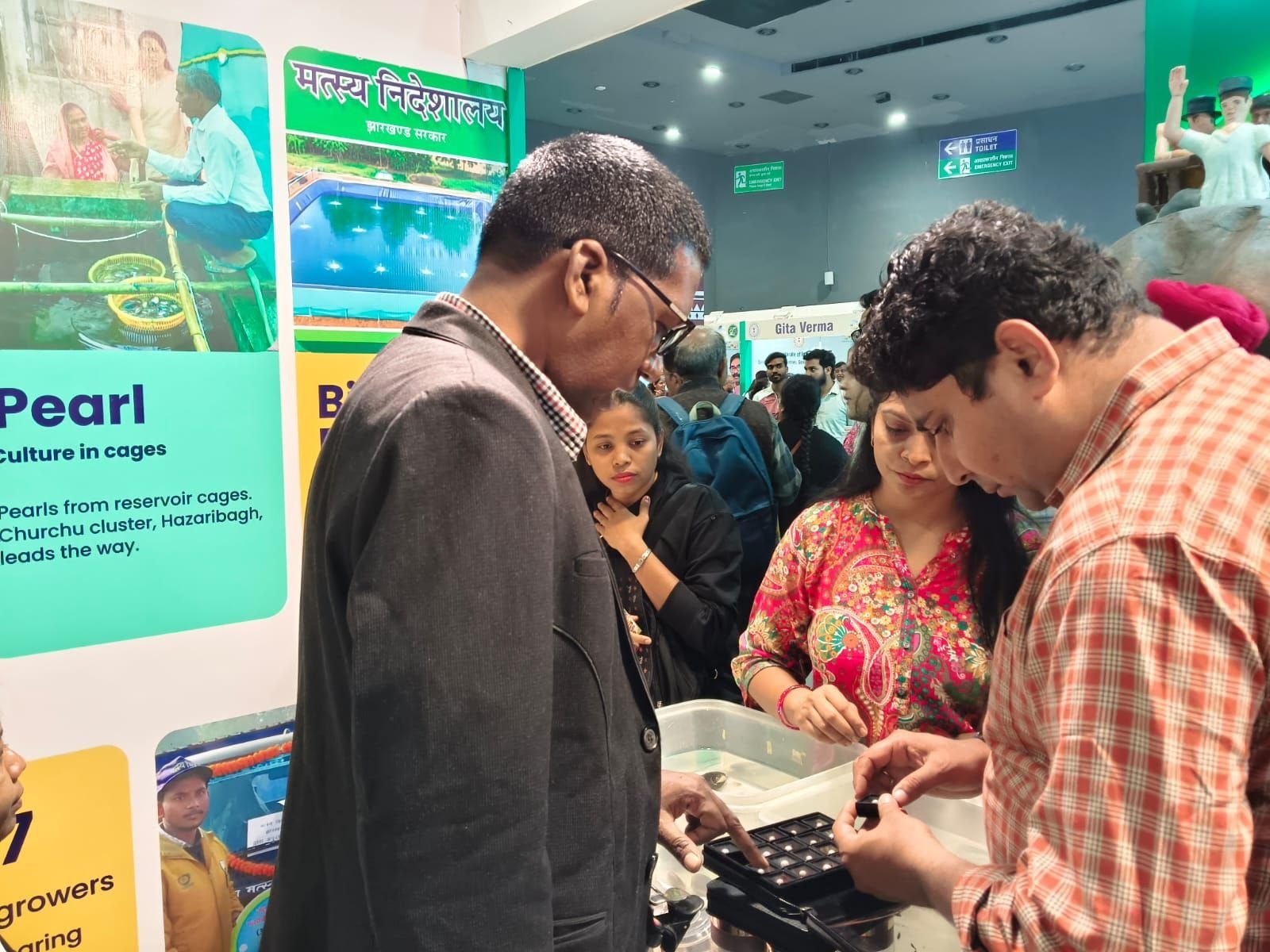
New Delhi/Ranchi: Pearl farming is emerging as a major attraction at the Jharkhand Pavilion during the India International Trade Fair (IITF)-2026, offering visitors a glimpse into the state’s growing fisheries potential and innovative aquaculture practices. The display highlighting modern pearl cultivation techniques and their role in creating rural livelihood opportunities is generating considerable interest among fairgoers.
The Jharkhand Government is promoting modern aquaculture practices alongside traditional fish farming to expand production and generate employment. Key initiatives include biofloc technology, cage culture, pearl farming, and shrimp and magur cultivation, opening up new avenues for income generation and self-employment.
Sharing insights into the state’s growing pearl farming ecosystem at the pavilion, fisheries expert Budhan Singh Purti highlighted the sector’s expansion from village ponds and reservoirs to wider national recognition. He said pearl farming is progressing across almost all districts of Jharkhand, with Hazaribagh being developed as a dedicated pearl farming cluster by the Government of India. A state-of-the-art Brood Bank is also proposed in the cluster to further strengthen pearl production and support farmers.
Highlighting the technological advancements, Purti explained that pearl cultivation has evolved from traditional half-round and perfectly round pearl production to the advanced mantle graft tissue technique. Under this method, seven to eight pearls can be developed simultaneously in a single oyster mantle without using an external nucleus. The resulting pearls contain approximately 97–98 per cent pure calcium carbonate, making the technique a significant development in pearl cultivation.

According to the Directorate of Fisheries, Jharkhand’s fish production reached 3.81 lakh metric tonnes in the previous year, while a target of 4.10 lakh metric tonnes has been set for 2025–26. The state is also encouraging women and youth to take up self-employment through the distribution of fish vending kits and three- and four-wheeler vehicles. Reservoir development, fisheries activities in mining pits and insurance protection schemes are further strengthening livelihood opportunities for fishing communities.
Meanwhile, the Department of Forest, Environment and Climate Change is also drawing visitors’ attention at the Jharkhand Pavilion with its display of the state’s rich forest resources and traditional products. Mahua, sal leaves, tamarind, lac, honey, bamboo and kendu leaves showcase the importance of forest produce in supporting rural livelihoods. Colourful lac bangles and bracelets, along with traditional mahua laddoos, are particularly attracting visitors, highlighting Jharkhand’s indigenous craftsmanship and forest-based products.
Through these diverse displays, the Jharkhand Pavilion is showcasing the state’s progress in fisheries, innovative pearl farming and forest-based livelihoods, bringing its natural wealth, traditional skills and emerging economic opportunities into focus at IITF-2026.